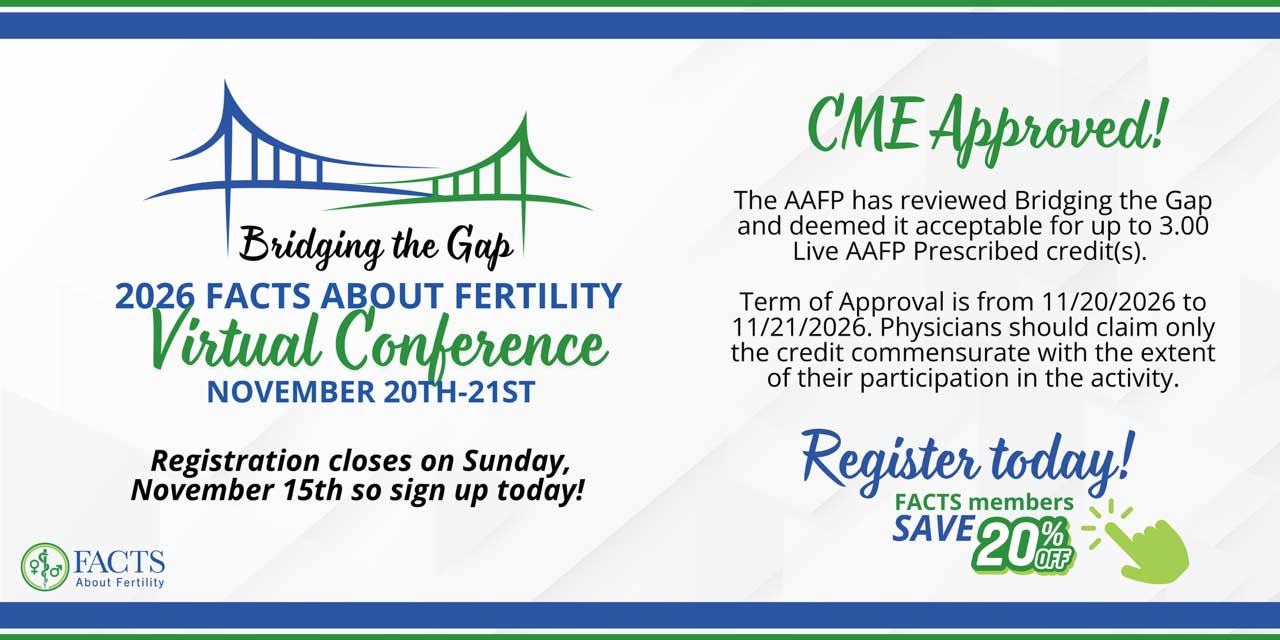

Editor’s Note: As a fourth-year FACTS elective medical student, Sakshi Bhatt summarized the research article by Ali et al (2026), which asked the question: “How well do women understand their menstrual cycles?” This timely article highlights the importance of the female cycle as a sign of health. However, it continues to reference the “menstrual cycle,” which fails to acknowledge that the main event of the cycle is ovulation—a result of the intricate orchestration of a woman’s hormones. At FACTS, we encourage our readers to refer to the female reproductive cycle as the ovulatory-menstrual cycle, highlighting the importance of ovulation as a sign of health. To learn more about ovulation and ovarian physiology, register today for our FACTS virtual conference on November 20-21, where Dr. Alison Ermisch will present on this important topic.
Introduction
Menstrual cycle awareness is an important aspect of reproductive health, yet many women have limited understanding of their own ovulatory-menstrual cycle patterns. Even though the American College of Obstetricians and Gynecologists, the American Academy of Pediatricians and others refer to the menstrual cycle as a vital sign of health [1][2], clinician education rarely addresses how to interpret cycle length, regularity, or bleeding patterns. This gap may delay recognition of reproductive health concerns and affect women’s ability to make informed decisions about their health.
“Even though the American College of Obstetricians and Gynecologists, the American Academy of Pediatricians and others refer to the menstrual cycle as a vital sign of health, clinician education rarely addresses how to interpret cycle length, regularity, or bleeding patterns.”

Ali et al. (2026) examined menstrual cycle awareness among women in the United Kingdom and how it varied by age, ethnicity, reproductive history, and contraceptive use [3]. The study assessed women’s knowledge of their cycle characteristics and whether perceived regularity aligned with clinically referenced cycle length parameters (21-35 days).
Methodology
The authors analyzed responses from a retrospective, cross-sectional analysis of self-reported data collected between September 2020 and January 2025 via an online health assessment. The study included 383,085 women aged 18 to 50 years residing in the United Kingdom. Importantly, “awareness” in this study reflected a participant’s ability to report characteristics of her cycle, rather than the accuracy of what was reported [3].
Participants reported cycles as regular, irregular, absent, or suppressed due to hormonal contraception or hormone replacement therapy. Additionally, they reported typical cycle length and menstrual bleeding duration with the option to indicate uncertainty. Demographic and reproductive characteristics, including age, ethnicity, pregnancy history, reproductive health conditions, and contraceptive use, were also collected. Descriptive statistics and chi-square tests were used to examine associations with menstrual cycle awareness. Cycle lengths were categorized as shorter than 21 days, 21 to 35 days, or longer than 35 days [3].
Results
Of the 383,085 participants, 60.7% described their menstrual cycles as regular and 26.5% reported irregular cycles. The remaining 12.8% reported no menstruation, predominantly due to hormonal contraception or hormone replacement therapy. Of the participants that documented menstruation, 22.2% did not know their cycle length and 9.5% did not know how long their periods typically lasted. Uncertainty was highest among women under 25 (33.4%). Awareness generally increased with age and was highest among women aged 36 to 40 [3].
Women actively trying to conceive demonstrated the highest awareness, with 82.5% reporting knowledge of their cycle length. In contrast, 36.3% of women using hormonal contraception were unable to report their cycle length compared with 16.7% of non-hormonal contraceptive users and 21.1% of women using no contraception. Women who had previously been pregnant were somewhat more likely to know their cycle length than those who had never been pregnant (79.2% vs. 77.2%) [1].
“Women actively trying to conceive demonstrated the highest awareness, with 82.5% reporting knowledge of their cycle length. In contrast, 36.3% of women using hormonal contraception were unable to report their cycle length.”
Among women who described their cycles as regular and knew their cycle length, 95.1% reported cycles within the commonly referenced 21- to 35-day range. However, 4.9% reported cycle lengths outside this range despite considering their cycles regular. This discrepancy was more pronounced among women under 25, of whom 7.2% reported cycle lengths outside the reference range [3].
Discussion
One of the most relevant findings of this study is that ovulatory-menstrual cycle awareness appears to develop reactively in response to reproductive experiences, rather than through routine health education. Women actively trying to conceive had greater awareness of their cycle characteristics, suggesting that fertility planning may encourage women to pay closer attention to their cycle patterns. However, menstrual cycle awareness remains relevant even when pregnancy is not an immediate goal. Delayed recognition of symptoms indicating reproductive dysfunction, like irregular periods or heavy bleeding, may lead to delays in diagnosis of polyendocrine metabolic ovary syndrome (PMOS), fibroids, endometriosis, or other conditions that can have profound impacts on women’s health and fertility.
“One of the most relevant findings of this study is that ovulatory-menstrual cycle awareness appears to develop reactively, in response to reproductive experiences rather than consistently established through routine health education.”
The discrepancy between perceived regularity and reported cycle length is also clinically relevant. A patient may describe her cycles as regular without realizing that their length falls outside a commonly used clinical reference range. Although not directly assessed, this study suggests that only asking whether a patient’s periods are regular may provide incomplete or inaccurate information. A more detailed ovulatory-menstrual history, including cycle length and changes over time, may help clinicians identify concerns that warrant further evaluation.
The study’s large sample size is a major strength, allowing researchers to examine menstrual cycle awareness across diverse reproductive and demographic characteristics. Its findings also extend beyond women seeking fertility care, framing menstrual cycle awareness as part of general reproductive health. However, the self-reported data may be subject to recall or reporting bias and the online assessment may have attracted participants who were already more engaged with their own reproductive health than the general population. The study also lacked qualitative data exploring why participants were uncertain about their cycles or how they understood menstrual regularity. Future research could examine how women learn about their cycles—including through family, school, healthcare, and digital resources—and whether integrating this education into clinical care and earlier health education might improve menstrual cycle awareness and encourage timely evaluation of concerns.
Cycle charting can help women develop a more accurate understanding of their ovulatory-menstrual patterns over time and provide insight into reproductive health beyond family planning. Consistently recording cycle length and menstrual patterns may help women recognize what is typical for them, identify changes or irregularities, and communicate these observations more accurately to their healthcare professionals.
“Cycle charting can help women develop a more accurate understanding of their ovulatory-menstrual patterns over time and provide insight into reproductive health beyond family planning.”
Overall, the findings of this study reinforce treating cycle health as a routine part of women’s healthcare rather than a topic limited to fertility counseling. For clinicians, teaching patients to observe and chart their ovulatory-menstrual cycles may provide one practical way to improve awareness of their own reproductive patterns and overall health. Fertility awareness-based methods can offer a framework for this type of cycle education, helping patients better understand their reproductive physiology whether they are trying to conceive, avoid pregnancy, or simply want to learn more about their health.
REFERENCES
[1] American College of Obstetricians and Gynecologists. Menstruation in Girls and Adolescents: Using the Menstrual Cycle as a Vital Sign. Committee Opinion No. 651. Obstet Gynecol. 2015;126:e143–e146.
[2] American Academy of Pediatrics. Menstrual Health and the Adolescent: Using the Menstrual Cycle as a Vital Sign. Pediatrics. 2015;135(3):e1122–e1131.
[3] Ali, Z.E., Wainwright, E., Murugesu, S. et al. How well do women understand their menstrual cycles? Insights from 383,085 UK based women. Reprod Health 23, 42 (2026). https://doi.org/10.1186/s12978-026-02275-3
ABOUT THE AUTHOR
 Sakshi Bhatt is a fourth-year medical student at Touro University Nevada College of Osteopathic Medicine and also pursuing a Master of Public Health in Global Health at Touro University California. She plans to pursue family medicine and is interested in preventive care, women’s health, and health equity. She enrolled in the FACTS elective to deepen her understanding of fertility awareness-based methods and menstrual cycle charting to help patients better understand and participate in their reproductive health.
Inspired by what you read?
You can support the ongoing work of FACTS here. To connect with a member of our team, please email development@FACTSaboutFertility.org. Interested in becoming an individual or organizational member? You can learn more and register here. To discuss with a member of our team, please email membership@FACTSaboutFertility.org.