
By: Mariel Padilla
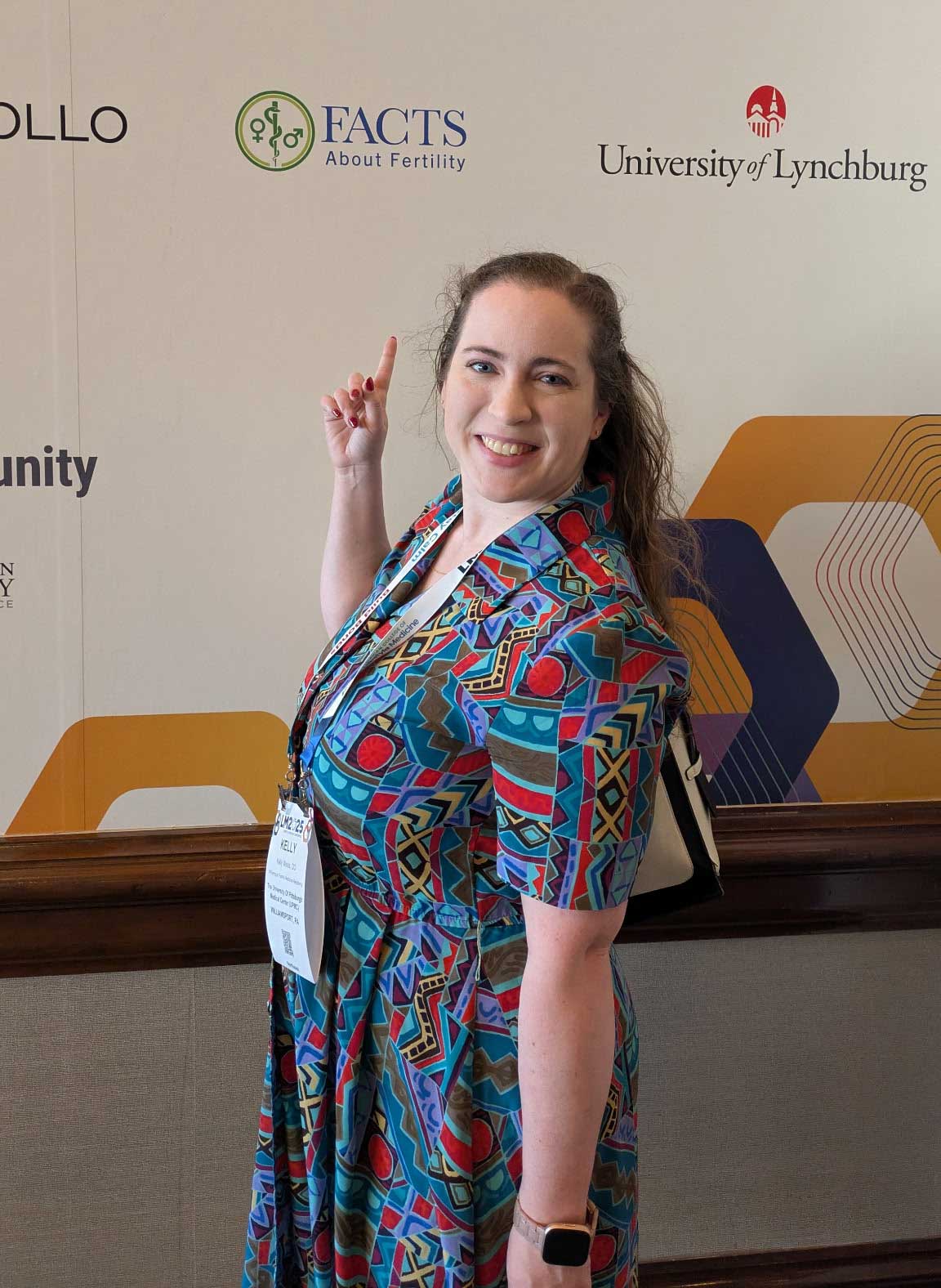
Editor’s Note: FACTS Ambassadors are medical or health professional students and residents from across the country (and the world!) who desire to learn more about fertility awareness-based methods (FABMs) and choose to share this information with colleagues to educate them about FABMs. This month, we are featuring Kelly Carlson, a fourth-year medical student planning to pursue family medicine with a focus on women’s health. Carlson, who recently became an ambassador last fall, shares how the FACTS elective has shaped her career trajectory.
Your contributions to FACTS enables us to offer this important elective to educate students, like Kelly, about FABMs, so please give a gift today to support our students!
Meet Kelly
Kelly Carlson was in her fourth year at Ohio University Heritage College of Osteopathic Medicine, and time was running out for her to decide whether to pursue residency training in obstetrics and gynecology or family medicine. Another student, a recent graduate of the FACTS elective, highly recommended that Carlson take the elective to learn more about fertility awareness-based methods (FABMs) and women’s health.
“I was really amazed by all the science behind FABMs,” Carlson said. “Like a lot of other students, we just weren’t really taught anything about these natural methods. We were led to believe that it was more like the calendar, or rhythm, method. I wasn’t aware of all the different methods there really are and all the science behind them and how well they actually work.”
“I was really amazed by all the science behind FABMs,” Carlson said. “Like a lot of other students, we just weren’t really taught anything about these natural methods.”
 After participating in the elective last fall, Carlson applied to become a FACTS ambassador, and decided she would pursue family medicine with a focus on women’s health.
“The FACTS elective made the decision for me,” Carlson said. “It completely changed my perspective and goals of what I want to do with my practice someday.”
During the course, Carlson said she learned more about the female cycle, what’s normal and what’s not. She saw how other residents and even some attendings seemed to have very little understanding of the specifics about women’s cycles: what was causing patients to have irregular bleeding or intense pain?
“There is so much more we could do as medical professionals if we just had a better idea of what was going on with the female cycle,” Carlson said. “It made me realize that I want to be able to provide more comprehensive care for my patients. I want to give them a better idea of how their bodies work and empower them to take control of that aspect of their lives. And I really loved all the medical applications that you can use to help women and treat many different gynecologic problems, in addition to using them for avoiding and achieving pregnancy.”
“There is so much more we could do as medical professionals if we just had a better idea of what was going on with the female cycle. I really loved all the medical applications that you can use to help women and treat many different gynecologic problems.”
As a FACTS ambassador, Carlson said she is now involved with monthly meetings where speakers talk about their experiences and mentor young medical professionals like herself. Carlson said it would have helped a lot to have been introduced to the science behind FABMs earlier in her medical school journey. She mentioned there was very little coverage of family planning and reproductive health content in the formal curriculum.
“During our first and second year, I think we had maybe one lecture on it,” Carlson said. “And natural family planning methods were mentioned, but we didn’t go into them. They expected us to get into the concept of contraception and family planning during our third-year rotation, but Ob/Gyn thought that family medicine was teaching it and family medicine thought that Ob/Gyn was teaching it — so no one was teaching it.”
Carlson got the sense that if she wanted to learn more about FABMs, she would have to seek out resources and educational materials on her own, outside of the classroom. Luckily, one of her classmates had taken the FACTS elective and told Carlson about it.
“If she wanted to learn more about FABMs, she would have to seek out resources and educational materials on her own, outside of the classroom. Luckily, one of her classmates told Carlson about the FACTS elective.”
Carlson’s impression is not that older medical professionals are necessarily biased against FABMs. Rather, many simply are not aware of the advancements in technology and research that have happened in recent years.
“A lot of my preceptors that I’ve worked with during third year and fourth year since taking the elective would have very outdated perspectives when I would bring it up,” Carlson said. “I think they don’t know what’s out there now and the science behind them. It would actually really help some of their practices.”
That is exactly why it is so important for ambassadors to share information about FABMs with other classmates, professors and working medical professionals, explained Carlson. She has also been sharing information with friends and family who are at the stage of life where they are considering pregnancy and growing their own families.
“I think it’s really empowering for women to be able to take control of their cycles and really have an investment in their health and be more aware of what’s going on,” said Carlson. “I want to take back some of that mystery. And sharing it with as many people as possible would be a good place to start. If more women go to their doctors and ask about it, then maybe that would spark a little bit more change within the medical community.”
ABOUT THE AUTHOR

Mariel Padilla
Mariel Padilla is a journalist working with us as editor of the FACTS blog. In her full-time job, Mariel writes about the intersection between gender, politics and policy — but she was introduced to the FACTS team by her brother, Dr. Mikey Padilla. When she’s not writing or editing, she’s probably reading, painting or playing with her niece and nephew who live down the street.
Inspired by what you read?
You can support the ongoing work of FACTS here. To connect with a member of our team, please email development@FACTSaboutFertility.org. Interested in becoming an individual or organizational member? You can learn more and register here. To discuss with a member of our team, please email membership@FACTSaboutFertility.org.