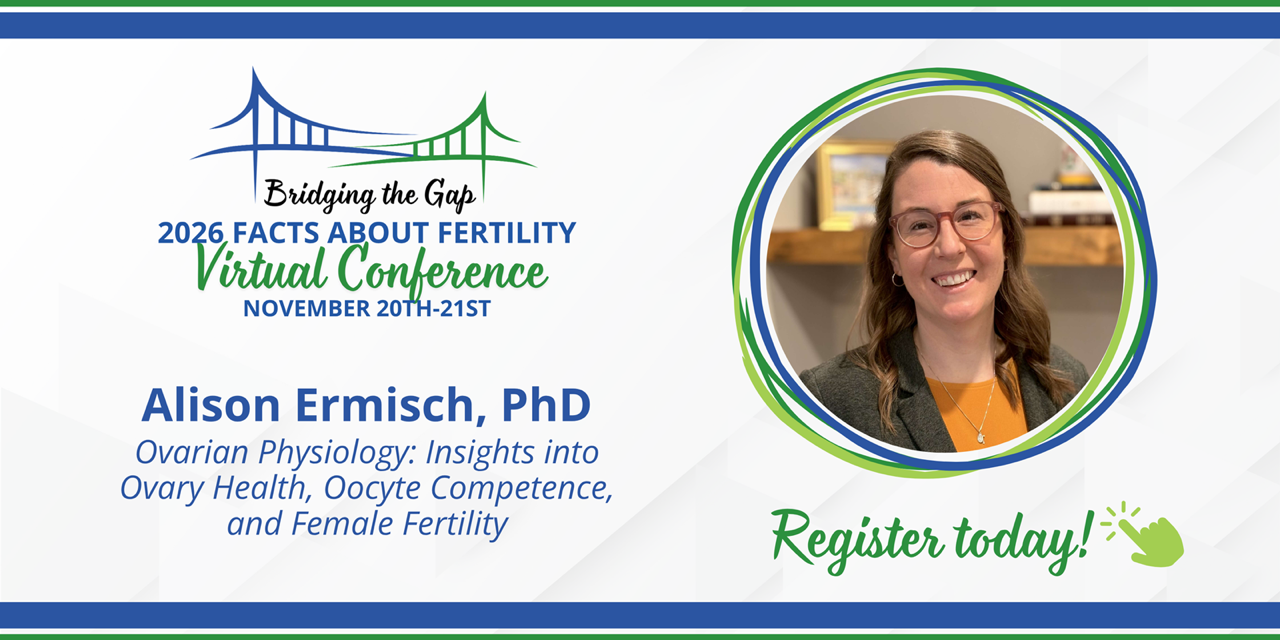

 Editor’s Note: How do cellular events relate to larger questions about reproductive function? Dr. Alison Ermisch, a member of the FACTS education team and a reproductive physiologist, will explore molecular insights into ovarian health, oocyte competence, and female fertility during her presentation, “Ovarian Physiology,” at the 2026 FACTS Virtual Conference on November 20-21. The conference was approved for 3 CME credits through the American Academy of Family Physicians, so sign up before registration closes on November 15th!
Alison Ermisch, PhD, developed an interest in reproductive science in a college classroom. As a pre-veterinary student at Cal Poly, San Luis Obispo, she realized her original career plan wasn’t the right fit. A comparative reproductive physiology course sparked her curiosity, and an animal embryology course heightened her fascination with early development.
“From there, my natural curiosity and constant thirst for knowledge led me to research,” she said.
Ermisch brings that same curiosity to her role at FACTS. After more than a decade in IVF-focused research, she is applying her scientific background to fertility and hormonal health education and reproductive medicine and helping future and practicing clinicians develop a more comprehensive understanding of women’s health.
“Ermisch brings that same curiosity to her role at FACTS … applying her scientific background to fertility and hormonal health education and reproductive medicine.”

Understanding Fertility at a Cellular Level
Ermisch earned her PhD in reproductive physiology from the University of Nebraska–Lincoln, where her doctoral research examined oocyte metabolism and ovarian physiology. Her work explored the molecular processes that support egg quality and fertilization, how external stressors such as inflammation and oxidative stress can disrupt those processes, and the implications for early embryo development.
That work required close attention to events occurring within individual cells. At FACTS, she has connected this detailed knowledge to broader questions about reproductive health.
“It really allowed me to zoom out and look at the whole person, rather than just a particular cell in the body,” she said.
Her scientific training shapes how she approaches fertility education at FACTS by connecting whole-body health, menstrual cycle patterns, ovarian function, and processes within an oocyte. For Ermisch, these physiological layers belong in the same conversation. Understanding their relationships can help learners ask more informed questions about reproductive dysfunction.
“Her scientific training shapes how she approaches fertility education at FACTS by connecting whole-body health, menstrual cycle patterns, ovarian function, and processes within an oocyte.”
A Personal & Professional Transition
Ermisch’s decision to leave IVF research came after a period of reflection on her faith and the ethical dimensions of her work. She wanted to pursue opportunities that better aligned with her convictions while continuing to contribute to women’s health and fertility research.
A mutual contact introduced her to FACTS co-founder Dr. Marguerite Duane. Their initial conversation lasted more than an hour as they discussed Ermisch’s training, professional background, and hopes for her next steps. She was drawn to the opportunity to help bring fertility awareness and restorative reproductive medicine education to medical students and clinicians.
The connection also had personal significance. After experiencing a miscarriage, Ermisch received progesterone during each of her three subsequent pregnancies. After speaking with Dr. Duane, she began to appreciate the role that training in cooperative and restorative healthcare played in her own patient experience. This strengthened her desire to help clinicians learn about approaches they might otherwise have limited opportunities to study.
Science and Ethical Inquiry
Ermisch’s interest in reproductive medicine includes sustained attention to its ethical questions. She previously served on the board of directors for the Society for the Study of Reproduction and currently serves on the board for the Center for Bioethics and Culture, where she is also a Paul Ramsey Institute fellow in bioethics.
She first encountered the Center for Bioethics and Culture while questioning her place in IVF research and examining the ethics of assisted reproductive technologies. Developments such as artificial intelligence in embryo selection, robotic IVF, and in vitro gametogenesis prompted her to consider how emerging technologies affect understandings of human dignity and responsibility.
For Ermisch, ethical inquiry also carries a practical obligation: to explore alternatives for people seeking help with reproductive health concerns. Her work at FACTS has given her an opportunity to learn more about holistic, restorative fertility treatments and contribute to education in that field.
Reaching Students with Different Perspectives
Although her own transition was shaped by faith, Ermisch emphasizes that students arrive at FACTS with a range of backgrounds and motivations. Some bring religious convictions; others want to understand fertility awareness or expand the options they can discuss with patients.
In her work with FACTS, she hears accounts of learners’ limited exposure to fertility awareness during medical training. These conversations reinforce her interest in helping students examine reproductive physiology more deeply and consider how ovulatory menstrual cycle observations may contribute to their understanding of a patient’s health.
“Learners’ limited exposure to fertility awareness during medical training … reinforce her interest in helping students examine reproductive physiology more deeply and consider how ovulatory menstrual cycle observations may contribute to their understanding of a patient’s health.”
The most meaningful feedback often comes when a student or practicing physician describes learning something they didn’t encounter in medical school. For Ermisch, those moments demonstrate the value of making this education available—and the possibility that it will inform future patient care.
Continuing to Learn & Ask Questions
“I love to teach, but I also love to learn,” Ermisch said. At FACTS, both are part of her work. She values the opportunity to engage with medical students and physicians from her perspective as a reproductive scientist while continuing to expand her own knowledge.
Her planned presentation for the FACTS 2026 Virtual Conference explores basic reproductive and ovarian physiology, including molecular insights into ovarian health, oocyte competence, and female fertility. It reflects the connections that animate her work: how cellular events relate to larger questions about reproductive function.
Looking ahead, Ermisch encourages students and researchers interested in women’s health to pursue research in female cycle tracking and cooperative reproductive and endocrine (CoRE) medicine. She sees a need for studies that rigorously evaluate clinical approaches and strengthen the evidence available to clinicians and patients.
For a career that began with a fascination of embryo development, that work offers Ermisch a continuing source of questions—and a way to bring her training into education that considers the whole person.
Inspired by what you read?
You can support the ongoing work of FACTS here. To connect with a member of our team, please email development@FACTSaboutFertility.org. Interested in becoming an individual or organizational member? You can learn more and register here. To discuss with a member of our team, please email membership@FACTSaboutFertility.org.